Sunday, January 31, 2016

The Tool Must Fit The Task- or, Physical vs. Digital Manipulation #SAMR


You might know that I love snapcubes. I think they are the most versatile type of thinking tool out there. I love how you aren't closed in to a single function, like many commercial manipulatives, and how tactile they are, how satisfying it is to snap them together and make something.They can be used in algebra, geometry, 2D and 3D measurement, playing with numbers, basically anything,

Cube tasks are their own genre of task, I think. There are lots just in the Ontario Spatial Reasoning monograph. 

Here is a version of the 5 cube task you can use with most grades, with interesting results:


Here's the thing with that picture: cubes are something Minecraft does really well, seeing as how they are the basic unit in Minecraft (1 m^3, supposedly, in the actual game!)

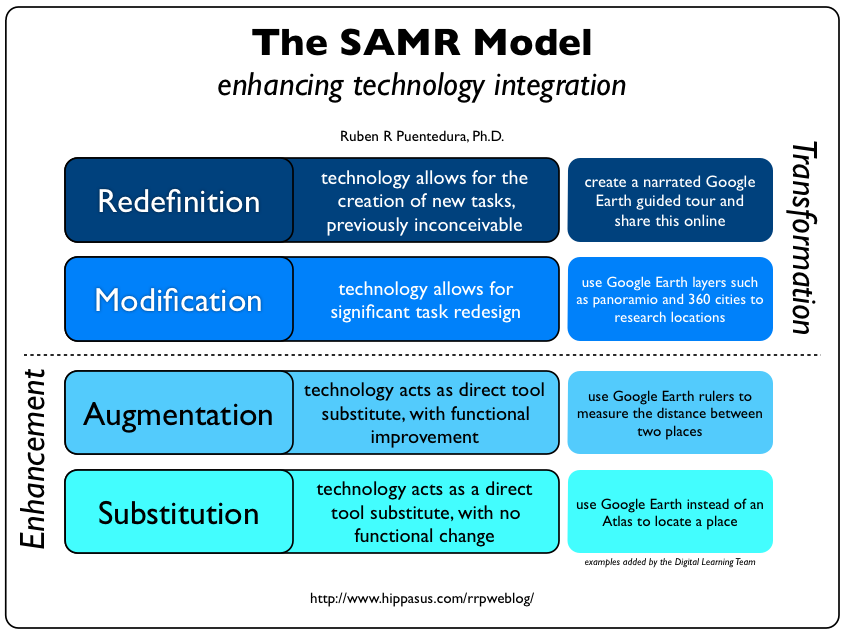
So you might think, as per the SAMR model, that Minecraft is automatically better than using snapcubes. Isn't it fresher, newer, shinier, more "21st century"?  

SAMR Model Figure

Not necessarily. Sometimes the original tools are better. 

I came to @MrSoClassroom with this task in mind:  


I thought, sure, we should offer Minecraft as an option, as well as snapcubes. I was persuaded otherwise?  Why? One tool was enough, and it was the one built exactly for the job. Sometimes (actually, many times), physical manipulation is better than digital manipulation. Figuring out how to do the task in Minecraft (for non-players) would have slowed them down too much.

Further, one face of each cube placed on the ground would be hidden from view. That is a big problem with trying to do this task in Minecraft.

But you know what, about the Minecraft picture above? It just might be easier in Minecraft. Why? You will never run out of cubes, while trying to build your structures, in an infinite world...

Saturday, January 16, 2016

Behold, The School of the Future!

One of the best stories you can read about schooling was written in 1951, by Isaac Asimov. Called "The Fun They Had", it's about a generation that knows nothing other than teaching machines, and reminiscences about a physical gathering place called "school". Asimov knew futurism (and partly invented science fiction), but he, so far, has proven to be way off with this fiction.

You can read it, and see what you think. Certainly we all have our opinions about what the "school of the future" will or should look like, based on our own experiences, biases, and interests. A large part of what we think should happen in schools in the future is, I think, dictated by how disposed we are to see the past as better, or worse, than the present time. (This is mirrored in the larger debates over traditional/progressive schooling, and probably conservatism/progressivism in politics).

Here is a current Australian vision for the "school of the future". It frankly doesn't seem much different than the type of schooling predicted by Asimov: "electronic with a capital E!" But then you actually read the article, and it''s talking about things like" VCRs, laserdiscs, and telephones. Yep, the "school of the future" is already out of date.

I used to teach science fiction to kids, and I like to use images of what people thought the future would look like. This Reddit has some nice posts that you can look at. The human mind can always leap farther with its dreams and ideas than technology can. Filmmakers like Stanley Kubrick never thought to go past 2001 with his space odyssey. The Back to the Future movies had their own ideas about what 2015 would look like (and, strangely, hoverboards are here now).

I think technological progress is slow, relentless, and sometimes, paradigm shifting. Iteration upon iteration seems to be the way a lot of technologies progress. A lot of things in my house would be unrecognizable to my great-grandparents, but many would not.

The question to ask yourself is this: would Dewey in 1915, recognize your classroom as a place of learning, in 2015? My guess is yes. Yes, he would also recognize "21st century skills" such as creativity and critical thinking. You could teach Mr. Time Traveller Dewey how to use an iPad, and chances are, he would enjoy your class. I suspect he would quite like the opportunity to learn with modern tools.

Here are my predictions for the school of the future:

  • kids will still learn in a room with teachers
  • schools will continue to use the technology of their day (hopefully very effectively)
I am comfortable saying very little else about the school of the future.

As for "22nd century teaching and learning", i'm sure it will look a lot like "21st century teaching and learning". 21st century teaching and learning is really teaching for "the now", as my friend Mary says. What I am trying to say here is that human interactions and relationships will still be paramount. The "'school of the future" will "Human with a capital H".


File:School of the Future street facade.jpg

The actual "School of the Future" in Manhattan

Sunday, January 10, 2016

On Student Mathematical Thinking

Keith Devlin's perspective on mathematical thinking, as presented in this blog post, has been influential in my own thinking about how students interact with mathematics in our classroom.

I am happy to accept this as a working definition for myself:

Mathematical thinking is a whole way of looking at things, of stripping them down to their numerical, structural, or logical essentials, and of analyzing the underlying patterns."'

This is not to say that I think novices (students) are always thinking like experts (mathematicians). I don't. School math and professional math are not the same things. But I do think that students can adopt the identities of (young) mathematicians in the same way that they can adopt the identities of (young) scientists: by using some of the tools of the disciplines as they work at their own levels. Students of all ages are encouraged to construct scientific hypotheses about the world, without controversy, whereas I think it is far too easy for us to present all school math as axiomatic, or even universal, without giving students a chance to see into the mathematical world themselves.

Keeping the expert/novice divide in mind, then, here are some things that students will generally NOT be doing:

-constructing proofs by contradiction
-developing theorems
-proceeding from rigorous logical structures like "there exists a..."
-using set theory

Some things that students will, and I believe should, be doing:

-developing their own reasoning, and "proving" things as true as they can, for any given task
-exploring truths about arithmetic, like commutativity
-systematically exploring why things like the formula for area of a triangle work for all triangles
-making generalizations using algebra, for example about a given linear pattern
-choosing the best "tool" for the job, whether it be adding, subtracting, multiplying, dividing, or higher powered tools, as they get older
-constructing models for how things "might" work, in the context of a given problem

Here is a nice piece that argues that mathematical thinking doesn't look anything like mathematics. If you don't believe that, I give your Andrew Wiles' proof for Fermat's Last Theorem: "Modular elliptic curves and Fermat's Last Theorem". Probably only a few hundred people in the world can read that.

For those keeping track, I am absolutely not arguing that any of these things are done in the absence of content.
I do believe that the content itself is the vehicle for thinking mathematically. I am also unabashedly on the side that says students aren't given enough chances to develop their own reasoning. Mathematical tools that just sit in the mental toolbox are no better than dusty old tools in my basement. They should be used.

I also think mathematical content should be presented for what it is, in discipline-based language. Even the viral Common Core problem on "5x3" was an ideal opportunity to teach kids of any age about commutativity. You might say kids can't handle that- I myself have seen grade 2s in @MrSoClassroom use the phrase "distributive property". A lot of our coaches are also exploring arithmetic in interesting ways with number talks. And yes, they are teaching standard algorithms as well, because that's part of the journey. But number talks might be an example of what Mr. Devlin is talking about-stripping down simple arithmetic into structural elements, then putting the elements together.

Students must be given the chance to work with lots of problems, in order be able to strip them down to their mathematical elements. As they learn more mathematical content, as the grades progress, they will be more able to do so. Sometimes we do that in a more structured way, such as giving a few problems that are obviously "about" Pythagorean Theorem. Other times, we might let students play with the structure of problems (I used to like having students write their own Pythagoras problems, to see what they could do with the problem structure).

Why not? Students come up with things much more interesting than the old "ladder against a wall". 

Even better is using that structure to explain something in the world, in this case, how televisions are sold:


A few pictures I still have and like that I hope illustrate some of these points about student mathematical thinking:


 A student created their own model for the final career point tally of 3 NHL players. He had to decide what method for projecting their career points, including a calculation method and what assumptions to use.


This one represents an attempt to systematize the thousand locker problem.  The deep structure of this problem is that all square numbered lockers are the only ones touched an odd number of times. For any student to understand that, they have to first come up with a tool that will help them find the structure. 


This problem is something about numbers on horse stable stalls. I forget. They made it all the way through a systematic organized list before realizing they could start to generalize about their results. 


This one represents a students' understanding of a dot pattern. She saw the structure as adding a group of three dots to the side each time. It was a big "a-ha" moment, and led her toward the algebraic expression that models this pattern.


This picture represents a students' choice of tool for a problem involving using a certain amount of fencing to enclose as much area as possible. Students were generalizing about the meaning of "squareness" with regard to area and perimeter.


This picture is one of my favourites, It represents a kid exploring the class of polygon called a "trapezoid", in order to attempt to figure out how you might get its area. It's exciting because it led to...


...the beginning of a generalization about trapezoids. In my experience, making statements about all cases, beyond ones that they have found themselves, is tricky. A nice article about how generalization develops in early algebraic reasoning is here. 


This one represents a generalization with algebra about a version of the tables and chair problem. Gradually students realize that the "+2" stands in for the two chairs on the end, that are always there, even as more tables are added. 

In summary, I believe that students are very much capable of mathematical thinking, even if they don't always "think like mathematicians". They need lots and lots of chances to break down problems into their basic structural elements, to explore their own reasoning, and to start to make interesting generalizations on their own. 


Tuesday, January 5, 2016

Hope #oneword

When I think of my #oneword for 2016, I don't think of anything specifically related to teaching and learning. I don't think of "rigour", "grit", "moxie" (apparently a thing  now?), or anything to do with technology or mathematics.

I won't take a stand for something new and trendy, and I won't take a stand against something I see as stale and old. In 2016 I would rather be for things, rather than against things, anyway. I am for optimism, and I am for hope. I don't believe the world is getting worse every day. It's getting better. I am conscious now, on the planet, and my consciousness, as of all humans, goes back and forth between hope and despair, between the darkness that we stare into, and the light that comes from within (or without, depending on your spiritual beliefs).

I am for being hopeful. I am for supporting each other, when we're struggling, or feeling down, hurt, or broken-hearted. I am for the mental health of our teachers, administrators and support staff. I am for supporting our students to be hopeful, even in the face of trauma and despair. Classrooms are places of hope. (You can ignore trendy arguments against "safe spaces", classrooms must, always, be safe spaces).

This will probably be seen as another post about putting human relationships above all else in our education systems, and it is. It's about sustaining hope in each other. It will probably be seen as another mental health advocacy post, and it is. Most struggles are struggles of the mind. Look around you- are you aware of the struggles inside each and everyone around you, even if they don't show on their faces, or come through in their words?

There are people around you who:

-stare down the vicious monster called depression on a daily basis
-struggle with dependency (particularly on alcohol- if you are an adult in this world, you know someone who struggles with alcohol- you just don't KNOW it)
-are critically ill, or have loved ones who are, or who struggle with chronic pain
-have unresolved trauma in their past
-have suffered through broken relationships, heartbreak, heartache
-everyday swallow the bitter pill of disappointment over unrealized hopes, dreams, aspirations

I could go on, but I won't. Be the "light in the darkness of misery" (E. Costello) for others, but above all, take care of yourself. As much as is possible, be hopeful. Be not so fearful, and know that everything has its equal, and its opposite. Light has darkness, darkness light. If you feel despair, you can feel hope. Be ever hopeful.


Light vs. Darkness by Ritesh Man Tamrakar 
(CC, Flickr: https://www.flickr.com/photos/_rmt_/5569820904)

Monday, December 14, 2015

Multiple Entry Points for Mathematical Tasks: Lessons from Phys Ed Teachers

We had an interesting discussion about mathematical tasks this morning, specifically, rich tasks, and what makes them so.

A principal in the room brought her unique physical education background to the discussion. If you have, say, your baseball unit happening, and you have some elite level players in your class, and some who have never touched a bat and glove before, how do you structure your classes?

I think it's fair to say you can deploy what Boaler, and others, call "low floor, high ceiling" tasks. Check out the YouCubed tasks here and see what you think of them. Further, you can recognize that some students will need more time with thinking tools, or exploring of concepts, where other will need more time on specific practice elements.

This brought to mind my own experiences in grade 9 phys ed class. I was only ever good at one sport, basketball. This was because of endless hours spent shooting baskets at the school down the street. This led to being on the basketball team. That year, the basketball unit in phys ed class happened in the middle of basketball season. The games in class were too easy. Most people didn't know how to play basketball at all. Having only this one single entry point to the game of basketball was probably quite frustrating to those who were just learning how to play. That said, those at lower skills levels would have benefited more from skills drills, than from being in a game they weren't prepared for.

I think we see something similar play out in our math classes. Many of our students come with prior knowledge of the topics that will be taught, especially as math is now more "out there" in the culture than ever. (If you don't believe me, ask your students what they know about pi!) Others will struggle to even enter the mathematical content, having gaps in their skills or conceptual knowledge, or a history of struggling with math.

The challenge for us then is structuring our classes so everything can have something to do that will challenge them, as they work toward understanding the big ideas of the math curriculum, and acquiring the skills they will need to progress.

Here is an example of a task, Four 4s, that I think nicely allows students at all levels to practice their operational skills. This is less a task, and more a class of tasks.  In other words, this task could easily generate many more extension or follow up tasks involving operations. "Use all/any operations to make a certain number/integer/fraction", etc. It is possible to enter with just adding and subtracting, then multiplying and dividing, negative integers, squares, exponents, square roots, and so on. In my experience, students who have the comfort with the basic operations will try and come up with more and more elaborate expressions- nested brackets, exponents raised to exponents, fraction bars, and so on.

Another example: change "basketball class" from my example to "integer class".

If our curriculum goal is understanding and being able to add and subtract integers, consider all the actions any given student (or small group of students, for guided explicit instruction) could take:

-working with 2 colour tiles to explore the zero principle
-working with number lines to understand  integers visually
-exploring a context for integers, like golf or temperatures
-doing a worksheet on adding and subtracting integers, if they are ready

Many more activities are possible. Having flexible groupings based on readiness, and providing direct instruction as needed are the key things here. The math teacher is more like a coach, providing feedback, guidance, and explicit instruction as needed. "Sage on the stage" and "guide on the side" are outdated descriptions of what we do- perhaps "coach in the middle" is more like it. Here is a piece I wrote on being a guide on the side, versus being a "coach in the middle".


Wednesday, November 25, 2015

How To Be A Good Reader, or, How To Get Better At Math

For some of us, we can no more go without reading than we can go without breathing. Famously, I used up all my Hardy Boys before we even got to Europe, when I was 7. We had to find some more books in English. I can't fall asleep without reading, even if it's just those two pages, as the words swim, and the book (or tablet!) falls smack on my face as I fall asleep. I need to read my entire Twitter feed, and all of my flips in Flipboard, at least once a day. I am a subscriber to that dying industry, newspaper delivery. I keep up as much as I can with Batman, and lots of other comics.

I read a lot.

I think i'm a pretty good reader.

Schools do a fantastic job of teaching reading strategies these days. That is, they get students to pay attention to the things that are happening in their mind as they read- visualizing, connecting to our own lives, or to other texts, and making inferences about what is to come. Schools do a great job at making these things that readers do explicit, and they do a pretty good job at providing an interesting variety of texts for kids to read.  They are doing an increasingly better job with digital texts, and needed critical literacy skills for "the now".

The best way to get good at reading is to read. A lot. Schools are very good at promoting literacy outside of schools, and parents of young children all know the importance of taking their kids to the library, and reading to them as much as possible.

This makes sense, right? After all, words are all around us. Being literate in the world is being able to read, the world. Kids, from the time they are in their baby seats, are looking around, trying to decode signs, or ads, to "read the world".

Do we make the same connections with math? How do you become a numerate person? (My outstanding Peel colleagues have written about the 4 roles of the numerate learner here.) I would argue we often don't know how. Either we never figured out how to transfer mathematics out of our classroom experiences, into the world, or our school experiences with math were so dreadful, we can't even imagine the thought.

The Ontario Council of Directors of Education has a new resource to help parents help their children with math. I  saw Lynda Colgan (Queen's) present this resource. In here words, parents know more math than they think, they just call it "common sense".  That squares nicely with my favourite definition of mathematics, from Jordan Ellenberg:  "the extension of common sense by other means.

Common sense to a plumber is using Pythagoras to fit pipes in small spaces. Common sense for me this morning was scrounging change for Callum's lunch order. Common sense to many of us is searching out the best deals on Black Friday. We deal with negative integers every year, around November, as Canadians.

Being numerate in the world is finding numbers in the world, yes, is "reading"the world with math. Many of us watched the Blue Jays make a deep run this October. Did you ever think about what needs to happen for a .299 batting average to go to .300? It's hockey season. What does a .908 save percentage mean to a goalie? What about a 6% shooting rate, if you're Ovechkin? What does it mean that 39.6% of us voted for the Liberal party? What is 50% off, then an additional 20% off that shirt?

Is infinity a number? (My own children want to know). 1+1=2 (That's Alec's favourite "number" right now). Are we there yet? (Not long now!)

Math is everywhere for us to find. To get back to the point of this blog post, the best way to get better at math is to do lots of math. Do your school math, if you are in school. Get curious and watch that Numberphile video about prime number encryption. "Play" with the calculator on your phone. Join a MOOC. (Who knows, you might be among the 6% of all people who actually finish the MOOC.)

If you have small children, let them play with money. Explore the meaning of the equal sign. Count a set of objects. Count again. And again. And again. Explore different ways of making 5. 10. Play with a hundreds square. Look at the cost of toys in flyers. Give them $10 to spend at the dollar store, and see what they do with it. Do math. Everyday. Just do math.

                                                     Baseball: the mathiest of all sports


How much wall space do you need for this t.v.? How much would the tax be?


Read. Read lots. 


Whole lot o' Costco mayonnaise! What's the unit rate?


What percent bigger is Olympic ice, compared to NHL ice? Why does that matter?


Friday, September 25, 2015

Connective Tissue and Bone: On Multiplication Facts

Jo Boaler is making the news again for her stance on teaching times tables. I don't wish to wade into that debate, per se, but to consider how personal and idiosyncractic our knowledge of multiplication facts can be.

I wrote this tweet because I am very curious about what mental models or imagery others may have when presented with multiplication facts:


The "see" part was inspired by an incredible Twitter conversation started a while back by @Sue_Cowley and @surreallyno.

The Storify of that discussion is well worth your time. I know it blew my mind.


I don't personally have access to any of the interesting mental models, visuals, strategies or schema that others report having. I just don't I can't wind back the clock to how I learned to multiply. I just have the schema I have. 7x8 ("fifty-six"). 8x9 ("seventy-two).

My working hypothesis is that I learned solely by rote (flashcards and worksheets).  I don't fully remember. If my hypothesis is true, my ability to break multiplication facts down, and find the connective tissue between them, came later, through repeated exposure to them, and lots of practice.


I am not willing to wade into the knowing vs. understanding debate here. I know this fact, and I understand what "64" means. But my 7 year old self didn't have the benefit of the more than 30 years of experience I was later to get with multiplication facts. Did my seven year old self "know", or "understand" that 8x8=64? I learned up to the 12 times tables, but I stumble on some of the 11 and 12 times table facts.

Children should have the opportunity to make sense of numbers, to play with them, and find what I call the connective tissue, the very fabric that makes up all numbers. I won't take a stand against automaticity, as an end goal, but I think the means are more important.* If my school aged self simply memorized the times tables, then didn't do any further work making sense of them, I probably wouldn't have the rich schema for numbers that I have. This is the worst case scenario described by Boaler and others. In my case, I had many more years of math to come, and I use a fair amount of math in my job.

Further, I would have liked things like playing dice or card games to practice facts, or listening to others share their thoughts and strategies during number talks. There's a lot of nice and balanced ideas in this Reddit thread about learning times tables.

I think that, especially in K-8, children should be encouraged to "play" with numbers-find patterns, break them apart, make connections between them. I used to do a lot of lessons with the hundreds square, do you know how many interesting tasks you can build from that?  Again, I am calling this the connective tissue of number (or lack of connective tissue, when it comes to primes, but that's another story). Maybe just learning multiplication facts on their own is all bone, no tissue.

I have since heard stories about professional mathematicians who stumble when presented with certain facts (like 7x8), or fellow teachers who use what they call "workarounds" with things like the 6 times table.  I'm not sure at this point though, what's a "workaround", and what's a "strategy". My mind is my mind, and yours is yours. We need tissue, and we need bone.

*I am also leaving aside the thorny, knotty issues of what constitutes "fluency", "automaticity", and "memorization". Others have covered that quite well.